
Responsible Gambling: Cashback Isn't a Loss-Chase Excuse

If you're reading this because something feels wrong: call the National Gambling Helpline at 1-800-522-4700 (US), the BeGambleAware helpline at 0808 8020 133 (UK), or your national equivalent. Free, confidential, 24/7. You don't have to be "addicted" to call — if the question is crossing your mind, the call is worth making.
The Honest Version of What This Site Is About
This site documents a casino rebate program in meticulous detail. That's useful information for players who were going to play at Pin Up anyway. It is not an argument that you should play more, lose more, or chase losses to trigger higher tiers. The whole point of the "real cleared value" framing I use throughout the site is to show you that cashback rebates only recover about 80% of headline, which is a reduction in losses, not a reversal. Every euro of cashback credit is sourced from a larger euro amount you already lost.
The most common cognitive trap around cashback programs is the idea that losses "don't count" because they'll be partly refunded. Mathematically that's wrong. If you lose €500 and receive €35 back as Tier 2 cashback with €28 in cleared value, you've still lost €472. The €28 reduces the sting, it doesn't erase the transaction. Pretending the rebate makes losses free is the beginning of chasing, and chasing is how a recreational budget turns into a problem.
Warning Signs I Watch For
From a decade in the affiliate space I've seen the same patterns appear in readers who contact me worried about their play. The top three warning signs: playing longer than planned to "hit Tier 2" or "hit Tier 3"; depositing more than you budgeted because you'll "get some back"; and chasing the missed 72-hour window by playing fast and loose with the clearing session to beat the clock. Any of those three behaviours is a signal to step back, not to push harder.
Other signs worth noticing: missing sleep to play, hiding play activity from a partner, borrowing to deposit, or feeling relief after a losing session specifically because you can now claim rebate. If you recognize yourself in any of these, please use the helpline numbers below before you place your next bet.
Setting Limits That Actually Work
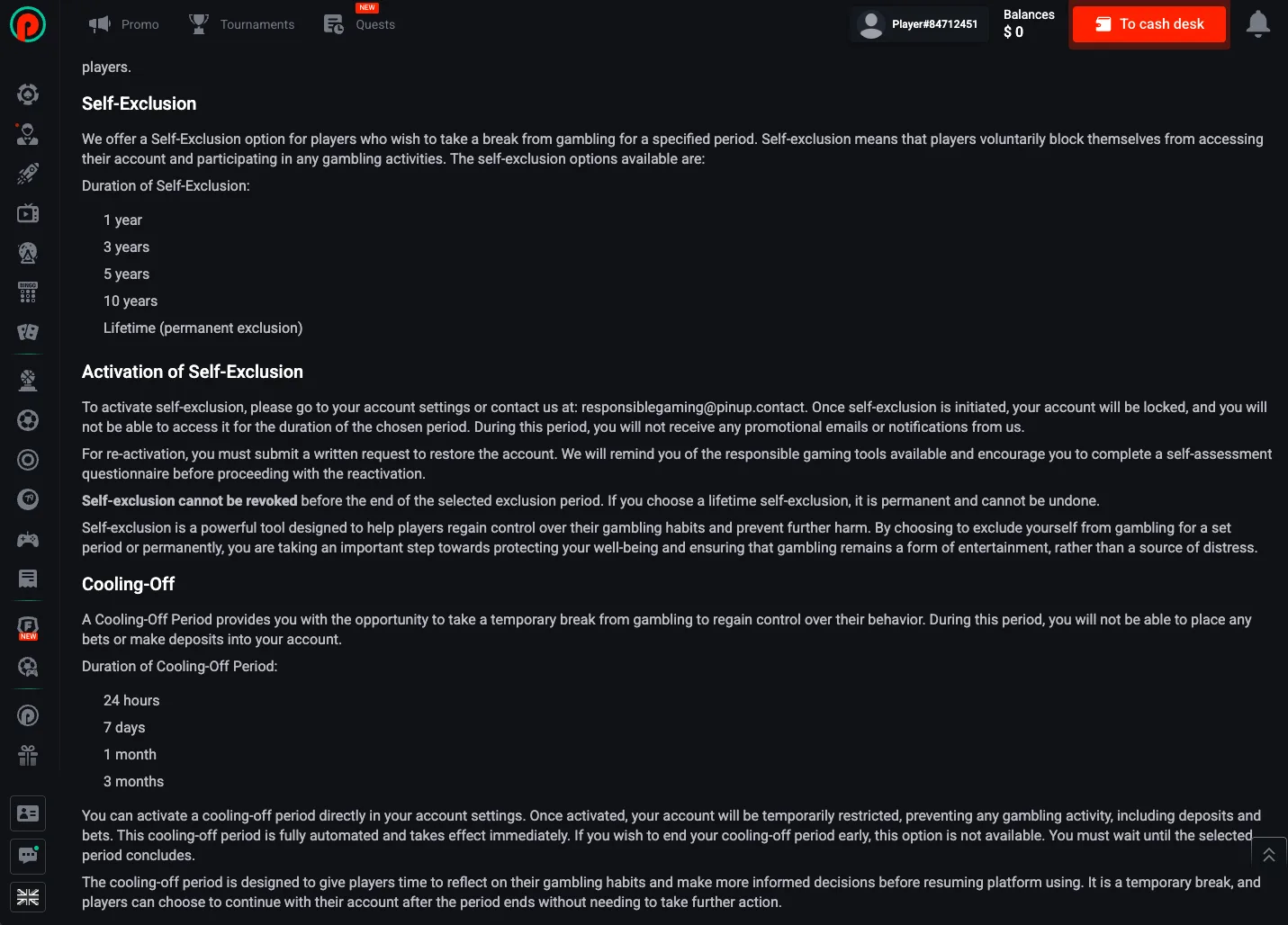
Pin Up provides deposit limits, session-time limits, loss limits, and self-exclusion tools in the account settings. Deposit limits are the most useful of these because they're enforced at the transaction level — once you hit your daily or weekly limit, you physically cannot deposit more until the period resets. I recommend setting a deposit limit equal to what you can afford to lose in full, not what you "intend" to lose. Assume you will lose every euro you deposit. If that full loss would cause financial stress, the limit is too high.
Session-time limits are also useful because they break up long sessions where loss-chasing becomes more likely. A 60-minute session limit forces you to log off and take a break; most players who would have kept playing will think better of it after thirty minutes away from the screen. Loss limits work similarly but operate on cumulative losses rather than time.
Self-exclusion is the nuclear option: you lock yourself out of the account for a defined period (commonly 1 month, 6 months, or permanent). Pin Up honours self-exclusion across its own platforms. If self-exclusion is what you need, don't hesitate — it's designed exactly for people who know they shouldn't keep playing but can't stop on willpower alone.
Resources and Helplines
International Helplines
- BeGambleAware (UK): Helpline 0808 8020 133, 24/7, free and confidential
- GamCare (UK): Helpline 0808 8020 133, structured support programs
- Gamblers Anonymous (International): peer support meetings
- National Council on Problem Gambling (US): 1-800-522-4700 helpline, 24/7
Self-Help Tools
- GamStop: UK self-exclusion scheme for online gambling sites
- Gamban: blocking software across devices, free for UK/Ireland residents
Why the "Chasing Tiers" Trap Is Especially Dangerous
Tiered cashback programs create an explicit incentive to cross loss thresholds. Tier 1 pays 5%, Tier 2 pays 7%, Tier 3 pays 10% — the structure rewards higher losses with higher rebate percentages. That design is fine for a disciplined player who stays within budget. It's dangerous for a player already near the edge of their budget because it whispers "keep going, you'll get more back." The whispered suggestion is math-flavoured but it's a trap: the additional losses always outweigh the marginal rebate. Tier 2 pays €21 on €300 losses (€279 net loss). Tier 1 pays €12.50 on €250 losses (€237.50 net loss). Crossing from Tier 1 into Tier 2 costs €41.50 in additional net loss to gain €8.50 in additional rebate. That's a 4.9x bad trade. Tier 2 to Tier 3 is even worse.
If you catch yourself thinking "one more session to cross into the next tier," close the tab and read this paragraph again. The math is bad and the psychology is worse. The site exists to document the program for players who are playing anyway, not to encourage you to play more. My Monday testing routine is a controlled experiment in which the deposit amount is budgeted in advance regardless of tier outcome. That's how cashback should be approached, period.
A safer way to use cashback information
The healthiest use of cashback data is retrospective, not motivational. In other words: play within your pre-set budget first, then use cashback information to understand what happened after the fact. The dangerous use is prospective: “if I lose another €80 I will reach the next band.” Good cashback discipline starts by treating the rebate as an accounting line, not a target.
That also means your calculator session and your gambling session should not be the same thing. If you are running cashback math while emotionally activated from losses, the numbers stop being neutral and start becoming permission. The safer routine is to review thresholds when calm, decide your budget before play, and refuse to update that budget mid-session no matter how close a tier looks.
If You Need to Stop Entirely
If reading this page has made you realize you need to stop gambling entirely, please close the Pin Up account, enable self-exclusion, and call one of the helplines above. There's nothing weak or embarrassing about stepping away — it's the single most rational decision you can make if the activity is harming you or someone who depends on you. The rebate isn't worth it. No rebate is.
A simple stop-rule for cashback players
If you want one rule that catches most bad cashback behavior, use this: never let a cashback threshold change today's deposit plan. That means the tier table is something you review before the week begins, not while you are down money. The moment the threshold starts influencing an emotional session, the rebate has stopped being informational and started becoming a trigger.
If you break that rule once, do not argue with yourself about whether the next exception is justified. Step away from the calculator, log out, and come back only when you can look at the numbers without needing them to rescue you.